/4 min read/Quantum/Scientific computing/quantum · gpu · cuda · cuquantum
How far does a single RTX 5090 get you in quantum simulation?
Statevector simulation is a memory problem before it's a compute problem. Here's the map — and the surprise I found where the wall was supposed to be.
Part 1 of 5One GPU, N QubitsAll parts →There’s a particular kind of fun in leveraging consumer hardware for a problem it was never marketed for. I have an RTX 5090 that nominally exists for games and AI workloads, so the obvious question: how big a quantum circuit can I actually simulate on it, at my desk, without touching a cluster?
This series is me finding out, with benchmarks you can rerun — every number comes from this repo, measured on the machine under my desk. The answer turned out to be more interesting than the single number I expected, because the wall I went looking for isn’t where the arithmetic says it should be. More on that at the end.
The exponential lives in memory, not in time
A statevector simulator is the bluntest possible instrument: store the entire quantum state, apply every gate as a small matrix multiplied into it. The state of qubits is a vector of complex amplitudes,
and that vector is the whole game. It doubles with every qubit you add. In
double precision – complex128, 16 bytes per amplitude. The ladder looks
like this:
| Qubits | Amplitudes | State size |
|---|---|---|
| 20 | ~10⁶ | 16 MiB |
| 26 | ~10⁸ | 1 GiB |
| 28 | ~10⁸·⁵ | 4 GiB |
| 30 | ~10⁹ | 16 GiB |
| 31 | ~10⁹·³ | 32 GiB |
| 33 | ~10¹⁰ | 128 GiB |
| 40 | ~10¹² | 16 TiB |
My card reports 31.8 GiB of usable VRAM (marketing says 32 GB; the runtime disagrees by a rounding error and reserves a slice for itself, about 30.2 GiB is actually free once CUDA is warm). So before thinking about speed at all, the arithmetic hands down a sentence: 30 qubits in fp64 fits with headroom, 31 is exactly the size of the card, and each further qubit doubles the bill. Drop to single precision and every row shifts one qubit to the right.
No amount of GPU compute changes the size of the vector you have to store. Compute is what you optimize after the state fits.
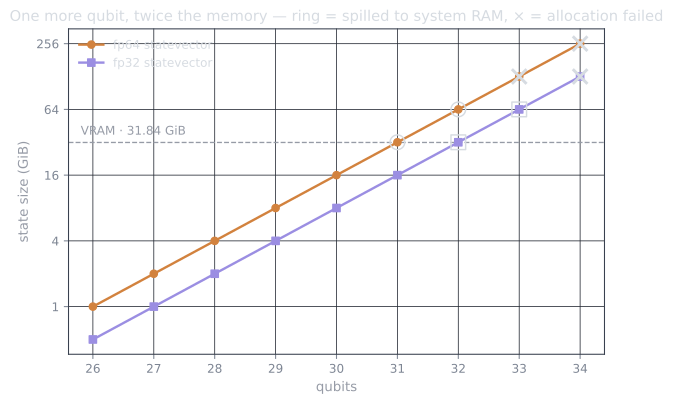
Why a gate is a memory operation
Here’s the part that makes GPUs the right tool and also caps what they can do. Applying a 1-qubit gate to qubit pairs up amplitudes whose indices differ in bit and hits each pair with a 2×2 matrix:
Four multiplies and two adds per pair (trivial math) but the pairs cover the entire statevector. Every gate reads and writes all amplitudes. At 30 qubits that’s 16 GiB read + 16 GiB written per gate. The work is almost pure memory traffic, which is exactly the regime a 5090 was built for: GDDR7 moves roughly 1.7 TiB/s, an order of magnitude beyond any CPU socket I’ll ever own. Part 3 measures how close cuStateVec gets to that ceiling.
What the series covers
- Part 2 — getting the stack alive on Windows via WSL2: the wheels, the three errors you’ll hit, and a Bell state as proof of life.
- Part 3 — real circuits and the scaling data: what a gate costs from 24 to 30 qubits, fp32 vs fp64, and why gate locality shows up in the timings.
- Part 4 — the wall itself. This is where the plot twisted.
- Part 5 — tensor networks: simulating circuits the statevector can’t hold, and the different wall you buy instead.
The spoiler, because field notes should be honest
I expected the experiment at 31 qubits to end with CUDA’s version of a shrug
— OutOfMemoryError, series over, wall found. That is not what happened. On
a current driver, the allocation succeeded, the free-VRAM counter pinned
to zero, and the gate quietly took orders of magnitude longer. The modern
“wall” is soft: the driver spills your statevector into system RAM behind
your back and lets performance absorb the damage.
Which means the real question isn’t “how many qubits fit.” It’s “how many qubits fit before the cliff, where’s the cliff, and how steep is it”. Those are measurable questions. Let’s measure them.