/5 min read/Quantum/Scientific computing/quantum · gpu · cuquantum · benchmarks
What a gate costs: statevector scaling on the 5090
Real circuits from 24 to 30 qubits, timed properly. The exponential shows up on schedule, the GPU runs at memory speed, and the QFT refuses to be slow.
Part 3 of 5One GPU, N QubitsAll parts →The stack is alive, the arithmetic says 30 qubits fp64 is the comfortable
ceiling. Time to run actual circuits and see what a gate costs as the state
grows. Scripts and raw JSON:
bench/02_gate_scaling.py
and
bench/03_sampling.py
in the series repo.
The protocol
Two circuit families, chosen because they stress the memory system differently, or so I believed when I chose them:
- random-local: a random phase + a Hadamard on every qubit, then a ring of CX. Friendly, textbook access patterns.
- qft: the quantum Fourier transform. controlled phases, increasingly long-range. The classic “poor locality” suspect.
Timing on a GPU has one iron rule: never trust the wall clock around async kernel launches. CUDA events, a warmup pass for the allocator and kernel autotuning, then the mean of three timed repetitions:
layer()                                  # warmup, discardedcp.cuda.runtime.deviceSynchronize()
start, end = cp.cuda.Event(), cp.cuda.Event()for _ in range(reps):    start.record()    layer()    end.record()    end.synchronize()    times.append(cp.cuda.get_elapsed_time(start, end))   # ms, GPU-side
The exponential, on schedule
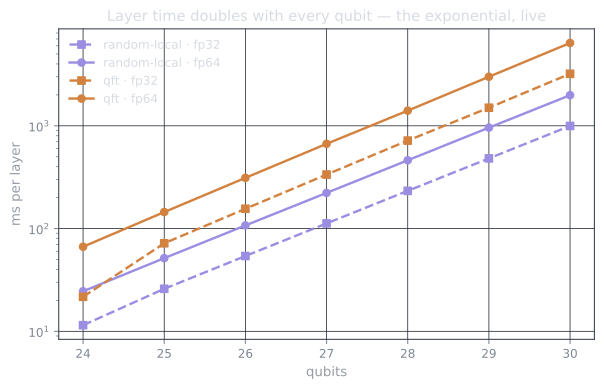
One random-local layer, fp64, mean of three runs:
| Qubits | State | ms / layer | ms / gate |
|---|---|---|---|
| 24 | 256 MiB | 24.5 | 0.34 |
| 26 | 1 GiB | 107.3 | 1.38 |
| 28 | 4 GiB | 461.7 | 5.50 |
| 30 | 16 GiB | 1,985.1 | 22.06 |
Every row is 2.07× the row two above it would predict: the doubling is so clean you could set a metronome by it. At 30 qubits, one layer of one gate per qubit takes two seconds. A thousand-layer circuit is a lunch break. The exponential doesn’t negotiate; it just hasn’t gotten steep yet.
The gate is a memcpy
Part 1 claimed a 1-qubit gate is really a full read + write of the state. The data agrees with unreasonable precision. Dividing traffic by time gives an effective bandwidth per gate, and for random-local it’s a flat line:
That’s 87% of the card’s ~1.67 TiB/s paper bandwidth, sustained across six state-size doublings, in both precisions. The compute units are idling; the memory controller is flat out. “Statevector simulation is memory-bandwidth-bound” isn’t a slogan, it’s a horizontal line.
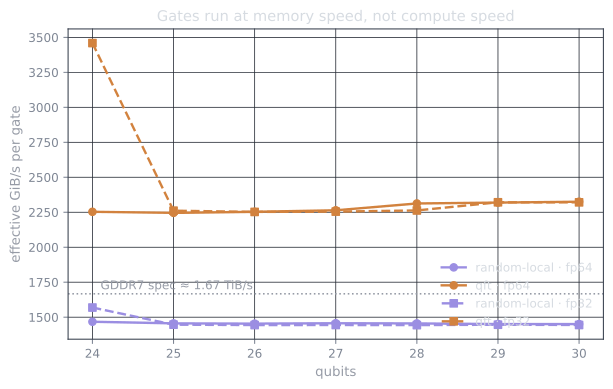
Corollary: fp32 is half the cost of fp64, almost to the digit. The ratio sits at 1.98–1.99 everywhere except the smallest size, where launch overhead wobbles it. You’re paying for bytes moved, not arithmetic done. Single precision buys one extra qubit and halves every gate time, at the price of numerical headroom you should actually think about before taking (norm drift over deep circuits is real; these shallow benchmark layers don’t probe it, so I won’t pretend they do).
The QFT refused to be slow
Here’s the part I got wrong in advance. I picked the QFT as the villain: long-range controlled gates, poor locality, surely the memory system suffers. The measurement:
| Family (30q, fp64) | ms / gate | “effective” GiB/s |
|---|---|---|
| random-local | 22.06 | 1,451 |
| qft | 13.76 | 2,325 |
The QFT is per-gate faster, and its apparent bandwidth is above the physical limit of the memory bus. A 5090 cannot move 2.3 TiB/s; when a measurement says it did, the traffic model is wrong, not the card. And it is: a controlled-phase gate is diagonal, so cuStateVec doesn’t pair up and rewrite the whole statevector for it. It multiplies the quarter of amplitudes where control and target are both 1, and touches nothing else. Less traffic per gate, more gates per second, model refuted.
Two lessons, one about physics and one about engineering: the cost of a gate depends on its structure, not just the state size. And the library is smarter than your mental model of it. Measure before you predict which circuit will hurt.
Measurement is nearly free (on a simulator)
A statevector simulator holds the entire distribution, so “measuring” is sampling from an array you already have. cuStateVec does one preprocessing pass (building the cumulative distribution, ~11 ms over an 8 GiB state, independent of shot count) and then draws are almost free:
| Shots | Preprocess | Draw |
|---|---|---|
| 1,000 | 11 ms | 0.9 ms |
| 100,000 | 11 ms | 2.9 ms |
| 1,000,000 | 12 ms | 22.8 ms |
A million measurements in 23 milliseconds. On hardware, a million shots is a coffee break and a calibration drift; here it’s a rounding error. When a simulation paper quotes gigantic shot counts, this is why nobody blinked.
My favorite detail in the whole dataset: sampling the uniform superposition over outcomes a million times returned 999,565 distinct bitstrings. The birthday problem predicts collisions; we observed 435, well within a Poisson deviation. The benchmark quietly contains its own statistical correctness test: the sampler is drawing from the distribution it claims to.
Where this leaves us
Thirty qubits, fp64, at 87% of theoretical memory bandwidth: a full QFT in 6.4 seconds, measurement effectively free. One desk, no cluster. The exponential is present but polite. Every qubit doubles the bill, and the bill is still payable.
At 31 qubits, the arithmetic says the state no longer fits. Part 1 spoiled that the card doesn’t throw an error there. What it does instead, and what it costs, is next.